
superluminal-stardust-pc-software (commonly known as Stardust by Superluminal) is a modular 3D particle system plugin engineered specifically for Adobe After Effects on Windows PC and macOS environments. Built to bridge the gap between 2D motion graphics and complex 3D particle simulation, it gives visual effects artists, motion designers, and broadcast compositors a single unified node-based workspace. Instead of forcing creators to manage multiple layers and disjointed effect chains, it combines particles, 3D models, volumetric lighting, spline primitives, and physics engines inside one central control interface.
Operating natively within After Effects as a GPU-accelerated plugin, the software leverages modern graphics processor pipeline architectures to render heavy particle counts, atmospheric volume lighting, and 3D geometry in real time. It serves professional post-production studios, freelance visual effects artists, graphic designers creating title sequences, and 3D animators seeking fast particle workflows without leaving their primary NLE environment.
Superluminal actively maintains the software across its Version 1.6 release branch (including Version 1.6.0), providing ongoing GPU render updates, high-DPI interface support, and compatibility across Windows 10, Windows 11, and modern Adobe Creative Cloud releases.
Your May Also Like :: Snipping Tool Installer PC Software
Key Features
The plugin incorporates a comprehensive node-based architecture, 3D object rendering pipeline, volumetric lighting controls, and physical simulation engines.
Node-Based Visual Workspace Unlike traditional After Effects plugins that rely on long, stacked layer lists in the Effect Controls panel, the application features an integrated node user interface. Artists can connect particle emitters, forces, fields, deformers, 3D models, and materials using visual wire connections, making complex multi-emitter rigs easy to organize and tweak.
3D Model and Primitive Rendering The software imports 3D geometry (.obj files) directly into After Effects. Users can emit particles from 3D mesh surfaces, turn 3D models into particle arrays, or render textured 3D objects alongside particle systems with realistic depth sorting and shadow mapping.
Volumetric Lighting and Atmospheric Shadows An integrated 3D volumetric light engine allows artists to cast volumetric beams, light rays, and atmospheric dust effects through particle fields and 3D geometry without requiring secondary third-party optical plugins.
Physical Dynamics and Force Fields Built-in physics engines handle particle collisions, gravity, wind turbulence, directional forces, and surface deflections. Particles can interact with custom 3D collision planes or wrap around procedural spline paths in real time.
Spline Emitter and Path Controls Artists can use After Effects mask paths or 3D splines as particle emitters, driving particles along custom paths for light trails, glowing streaks, or organic liquid flow animations.
Deformers and 3D Text Tools The plugin includes procedural deformers (such as noise, bend, twist, and stretch) that manipulate particle fields and 3D objects. Integrated 3D text tools allow users to extrude live After Effects text layers into fully textured 3D titles directly within the particle scene.
How Superluminal Stardust PC Software Works
The operational workflow flows logically from layer creation and node setup to final GPU rendering inside After Effects.
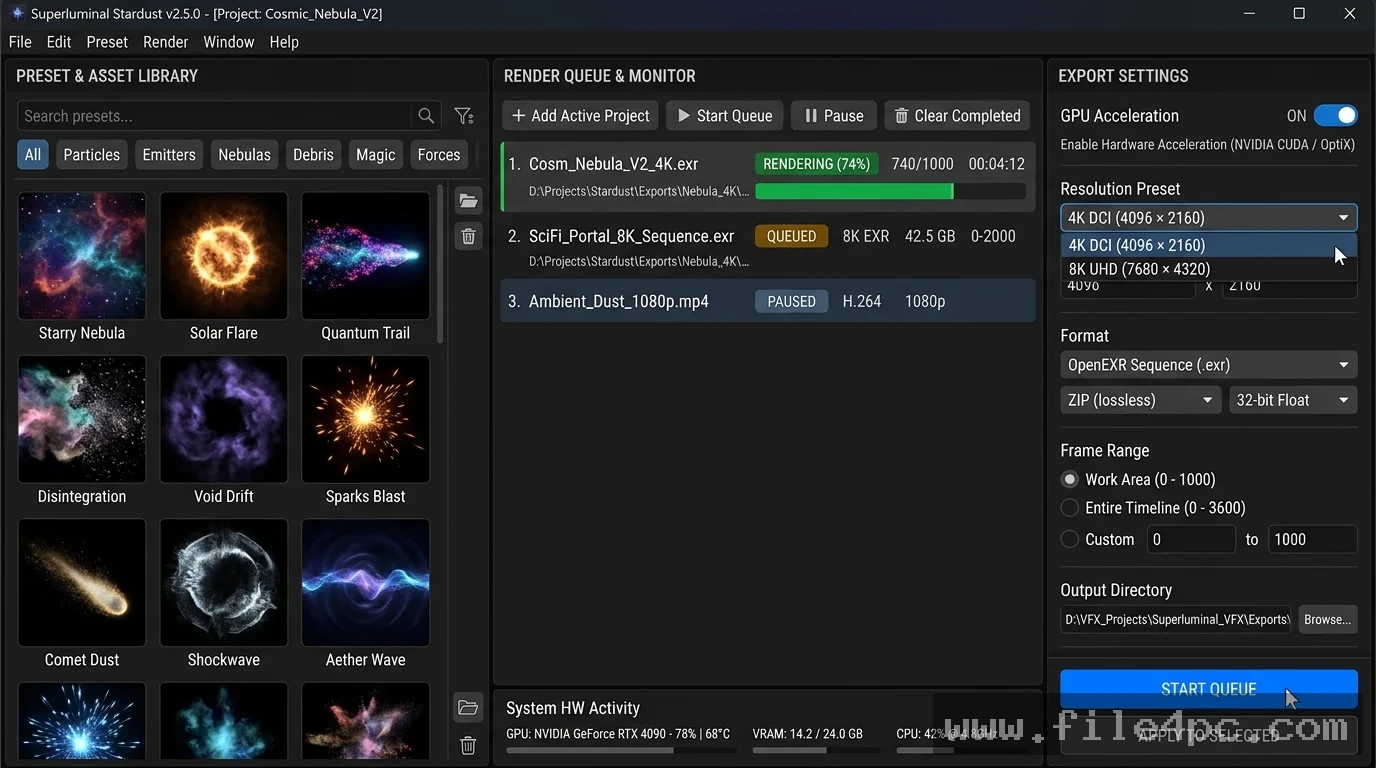
To begin, create a standard Solid Layer in an active After Effects composition and apply the plugin from the Effects panel. The application opens its custom node control window alongside the standard Effect Controls interface.
Next, build your particle system graph inside the node window. Drag an Emitter node and connect it to a Particle node. Add a Force or Turbulence node to control movement physics, or connect a 3D Model node to emit particles directly from the vertices of a imported 3D mesh file.
Finally, tweak materials, lighting parameters, and camera perspectives. The software reads native After Effects composition cameras and light sources, automatically matching render perspectives, depth of field, and shadow directions. The GPU rendering engine processes the node network in real time, delivering composite frames straight to the After Effects timeline.
Benefits and Limitations
Weighing the software's functional strengths against its system dependencies helps determine its place in a motion graphics pipeline.
Benefits
The primary advantage is workflow integration and flexibility. Combining node-based particle graphs, 3D model importing, volume lighting, and physical dynamics within one plugin eliminates the need to jump between external 3D software (like Cinema 4D or Blender) for routine particle work. Its node-based layout makes complex particle interaction transparent, while GPU hardware acceleration delivers fast preview updates during scene setup. Furthermore, purchasing a commercial license grants perpetual usage for host installations.
Limitations
The main limitation is that the software functions exclusively as an Adobe After Effects plugin, meaning it cannot run as a standalone desktop application or operate inside non-Adobe software like DaVinci Resolve or Final Cut Pro. Additionally, scene rendering relies heavily on host graphics card capability; older GPUs with low VRAM allocations can encounter performance slowdowns during dense volumetric particle renders.
What's New
Superluminal updates the plugin architecture periodically to enhance GPU execution, host NLE compatibility, and tool capabilities.
Key verified features in the Version 1.6 release series include:
-
Expanded Volume Engine: Improved volumetric light rendering algorithms with faster shadow mapping passes.
-
3D Model Instancing Optimizations: Upgraded GPU memory management when instancing thousands of 3D object duplicates across particle grids.
-
High-DPI UI Scaling: Refined node workspace graphics for crisp rendering on 4K display monitors.
-
Adobe CC Host Compatibility: Verified execution stability across modern Adobe After Effects versions on Windows 10 and Windows 11 64-bit systems.
Installation and Setup
Installing the plugin on a Windows PC involves a standard setup routine.
-
Download the official setup installer executable directly from the Superluminal website or authorized plugin portals like aescripts + aeplugins.
-
Ensure Adobe After Effects is closed before starting setup.
-
Run the installer wizard (
Stardust_Setup.exe), select your installed After Effects host version directory, and complete setup. -
Launch After Effects, create a new composition, add a Solid Layer, and choose Superluminal > Stardust from the Effects menu.
-
Enter your purchased license key in the plugin registration dialog to activate full rendering functionality.
Tips for Using Superluminal Stardust PC Software
Organize complex node setups into clean sub-graphs. Labeling your Emitters, Forces, and Material nodes within the visual node window prevents confusion when working with complex multi-emitter scenes containing dozens of connected nodes.
Use native After Effects 3D Cameras and Lights. Because the plugin reads host camera tracking and point lights automatically, matching particle depth of field and scene lighting to pre-existing composition elements requires no manual coordinate matching.
Lower particle preview density during initial scene building. Reducing emitter birth rates while setting up complex physics forces speed up interactive previews, allowing you to fine-tune movement before turning up full particle counts for final rendering.
Modern Alternatives
Depending on whether your workflow requires traditional layer-based particle tools or full 3D suite integration, several alternative solutions exist.
Trapcode Particular (by Maxon / Red Giant) is an established 3D particle plugin suite for After Effects. It offers an extensive preset browser, designer interface, and organic fluid dynamics. Unlike Stardust's single-window node layout, Particular uses a layer-based effect stack alongside its standalone preview interface.
BCC Particle Array 3D (by Boris FX) is part of the Continuum plugin package. It provides particle emitter controls, 3D text extrusion, and image-shattering effects across multiple host NLEs, including Adobe Premiere Pro, After Effects, and DaVinci Resolve.
Blender 3D Geometry Nodes is a free, open-source 3D creation suite. While it is a full standalone 3D software rather than an After Effects plugin, its node-based geometry and particle nodes system provides powerful procedural animation and simulation tools for visual effects artists willing to work outside an NLE workspace.
Who Should Use Superluminal Stardust PC Software?
This software is ideal for motion graphics artists, visual effects compositors, 3D animators, and broadcast designers who work inside Adobe After Effects. If you need a node-based particle system capable of handling 3D model emission, volumetric lighting, physics, and text extrusion without leaving your NLE timeline, it provides a comprehensive workspace.
However, editors using non-Adobe platforms (such as DaVinci Resolve or Final Cut Pro) or artists seeking dedicated standalone 3D animation suites will find tools like Blender, Cinema 4D, or cross-platform plugin packages better suited to their editing environments.
FAQ
Is Superluminal Stardust PC Software free or paid?
The software is commercial plugin software requiring a paid license key. A free trial version is available for evaluation, which renders a light watermark across final output frames until registered.
Does the plugin run as a standalone desktop program?
No. The software is built specifically as a plugin module and requires a host installation of Adobe After Effects to run.
Can I import custom 3D models into the particle system?
Yes. The plugin supports importing standard 3D file formats (.obj), allowing you to use 3D meshes as particle emitters, instanced particle shapes, or rendered scene objects.
Does the plugin support GPU hardware acceleration?
Yes. The rendering pipeline utilizes local GPU hardware acceleration to process heavy particle counts, volumetric lighting, and 3D geometry.
Conclusion
superluminal-stardust-pc-software provides an authoritative, highly versatile node-based particle environment for visual effects and motion graphics production. By integrating 3D model rendering, volumetric lighting, spline paths, and physics simulations into a single After Effects workspace, it simplifies complex visual creation.
While using the plugin requires a commercial license and an Adobe After Effects host environment, its GPU-accelerated rendering, intuitive node interface, and deep composition integration make it a top-tier asset for post-production professionals. For motion designers seeking powerful particle controls directly inside their main compositing timeline, it delivers an outstanding platform.


💬 0 Comments
✍ Leave a Comment